Ingredients
Equipment
Method
Trim & Season
- Trim the brisket down to about ¼" of fat over the flat. Round out the thin, wispy edges and trim down the thick fat deckle where the point and flat meet. Here’s a good trimming video if you want to see it done. Save the trimmings — they’re good for making tallow.
- Pat the brisket dry with paper towels.
- Coat the whole brisket in a thin layer of yellow mustard.
- Season generously on all sides — including the nooks and crannies — with coarse salt and coarse black pepper. When it looks like too much, it’s usually about right.
Smoke (Before the Wrap)
- Preheat the smoker to 225°F.
- Place the brisket fat side down, point toward the hottest part of the grill and flat facing away from it.
- Fill a disposable loaf pan with about 2 inches of water and set it on the grates next to the flat. It acts as a heat sink and keeps a more humid environment around the leaner side of the brisket while the fattier point renders.
- Insert one probe into the thickest part of the point and one into the center of the flat.
- Smoke until the flat probe reads 150–160°F (the stall).
Wrap the Brisket (Texas Crutch)
- While it smokes, lay out a sheet of butcher paper or foil about three times the length of the brisket — long enough to wrap it lengthwise twice.
- Spread half the tallow over the paper.
- Once the flat hits 150–160°F, pull the brisket and set it fat side down on the tallow. Spread the rest of the tallow on top, then wrap tightly, pressing out any air pockets and sealing every seam so no steam or fat can escape.
Smoke (After the Wrap)
- Return the wrapped brisket to the smoker.
- Keep smoking until the flat probe reads 200–203°F. Start checking for probe-tenderness around 190°F — you want the probe to slide in like it’s going through soft butter, with no real resistance. Check every 30 minutes or so once you’re in that window.
- It’s fine to creep a little past 203°F if it needs it, but pull it once it hits about 208°F either way.
Rest
- Pull the brisket and open the wrap for about 20 minutes to let it “burp” — this lets the built-up steam escape so the bark doesn’t turn soggy.
- Re-wrap it, then rest it in a cooler lined with an insulated bag or towels for at least 2 hours. This isn’t just a warming step — it’s carryover cooking and moisture redistribution, and it matters more for the flat than the point since the flat has less fat to fall back on if you skip it.
Slice
- Separate the point from the flat by cutting along the seam of fat that runs between them.
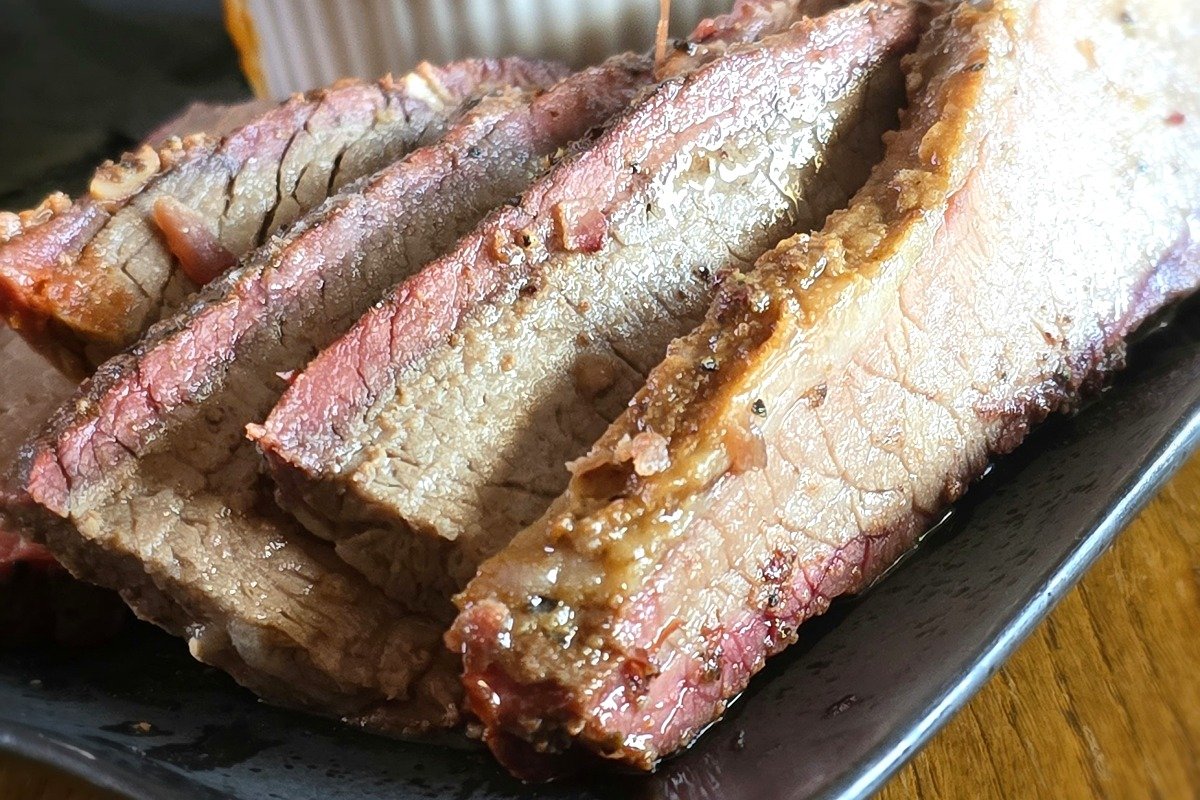
- The two pieces don’t run the same direction. Slice each one against its own grain — for the flat that’s usually straight across from one long edge to the other; for the point you’ll often need to turn the piece 90 degrees partway through to keep cutting against the grain there too. Slicing with the grain instead of against it is one of the easiest ways to make a perfectly cooked brisket taste tougher and drier than it actually is.
Notes
This recipe is for a full packer brisket. Plenty of pitmasters do it differently — this is just what works on my smoker.
Total cook time will vary quite a bit with brisket size and how your smoker holds temperature — budget somewhere in the 10–14 hour range for a full packer at 225°F, and always cook to probe-tenderness and temperature, not the clock.
🛍️ Shop the gear I used in this recipe